In 1951, Jackson Pollock was at the height of his career.
His drip paintings had made him one of the most famous artists in America. Pollock had accomplished something extraordinarily rare: critical and commercial success achieved in his lifetime. (Later, we’ll examine why it’s so hard for an innovative artist to achieve commercial success in their lifetime.)
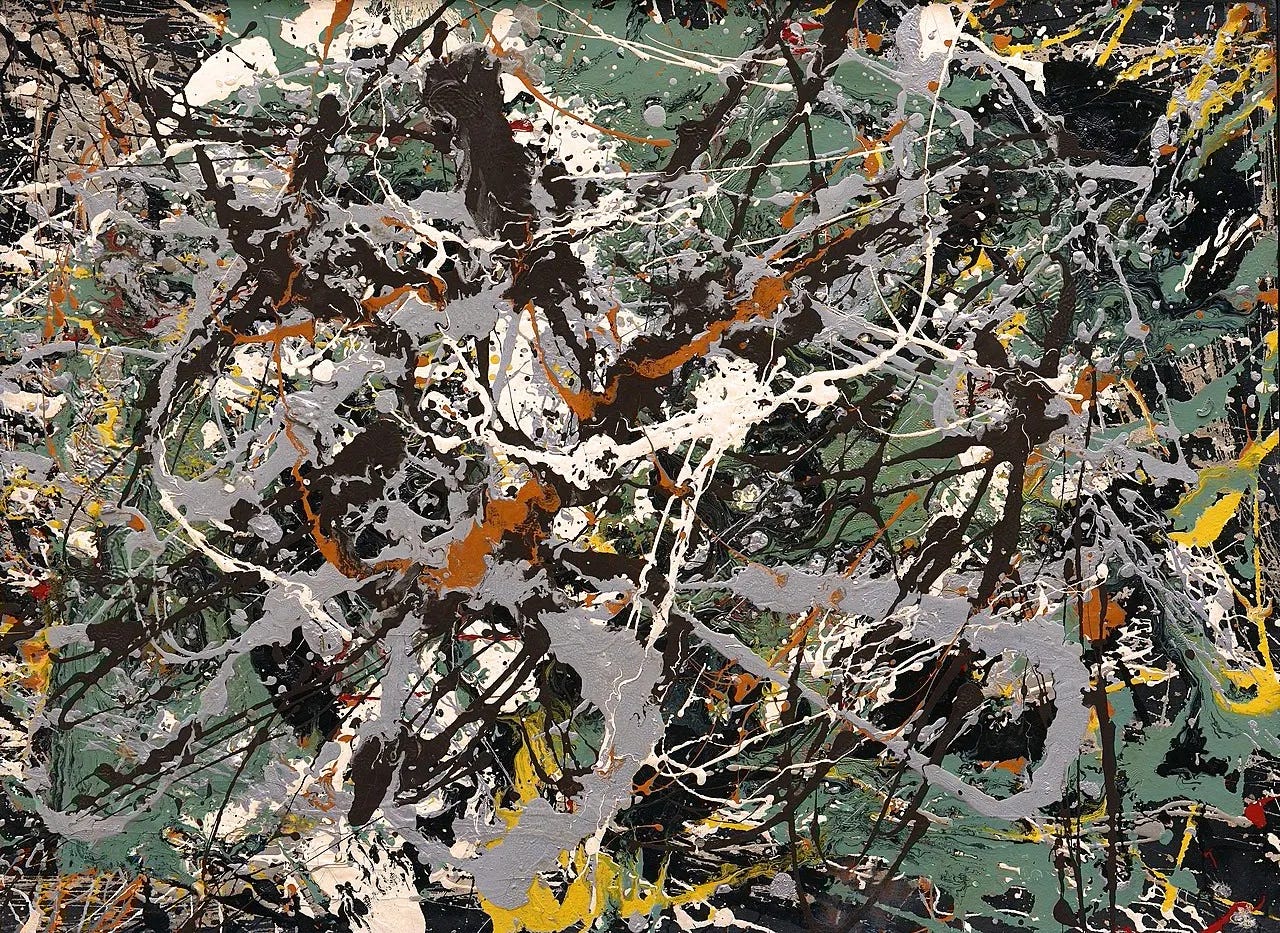
Then, Pollock changed direction.
He began making what became known as his Black Pourings. They were darker and more figurative than the colorful, chaotic paintings that had made him famous. Pollock confidently entered a new creative chapter, but his audience was less convinced. The paintings sold poorly and were greeted skeptically by many of the critics and collectors who had embraced his earlier work.

Had Pollock suddenly lost his taste?
That’s not quite the right question.
His artistic vision had changed, but the taste of his audience had not changed with it.
This distinction gets at something fundamental about taste that we often misunderstand. We tend to talk about taste as though it is an objective quality. Someone has “good taste.” Someone else has “bad taste.”
But, I contend… there is no objectively good taste.
Taste is ultimately about making choices among a landscape of possibilities. And whether those choices are good depends on who you are making them for.
Taste is curation
When we think about creative work, we tend to focus on the act of creation: writing the sentence, painting the canvas, composing the song, designing the product.
But I think taste is less about creation than it is about curation.
Taste is the process of looking at a set of possibilities and making a decision about which one is right.
That means one of the most important parts of taste happens before you choose anything. You need to understand the landscape of options.
An interior designer with developed taste doesn’t simply pick the best of the five chairs placed in front of them. She has enough of a sense of the possibility space to know whether the right chair is even there.
The same thing is true of writing, design, film, food, products, and almost any other creative domain.
Taste is not just choosing… it is knowing what could be chosen, deciding what matters, and curating those decisions into an end product that feels right.
But right for whom?
Why you have impeccable taste
Let’s think about taste on a spectrum. At one end of that spectrum is personal taste, or “taste for one”. The creator can create entirely for themselves. Imagine you are choosing a painting or making a photograph to hang in your living room. Your taste is the only taste that matters… there is no reason for your choices to appeal to anyone else.
At the other end is commercial taste: the ability to create something that resonates with millions of people.
Somewhere in between is what we usually call “good taste.”
Good taste is simply the preference of a relatively small set of tastemakers who have been given the authority to anoint particular choices as good or bad. Art curators. Fashion editors. Restaurant critics. Film critics. Design leaders.
Their taste matters if they are the audience you are trying to reach (often because they are the gatekeepers to a much larger audience).
If you are a chef seeking a Michelin star, it matters a great deal whether your taste overlaps with the taste of Michelin inspectors. If you are making a movie primarily for critical acclaim, the preferences of film critics matter. If you’re designing something for a sophisticated design audience, that design community’s conventions and sensibilities matter.
But none of those forms of taste is inherently more legitimate than commercial taste or personal taste.
Sometimes critics and broad audiences agree. Sometimes they don’t. You can see the divergence plainly on sites like Rotten Tomatoes, where critic scores and audience scores can look like evaluations of entirely different movies.
If your goal is to make something millions of people love, the critic’s taste may be irrelevant. The taste that matters is the taste of the audience you are trying to reach.
Taste is not craft
People often conflate taste with craft, but the two are different.
Taste is knowing what you want to create. Craft is the ability to create it.
Everyone has taste. We all have movies we love, music we return to, products we admire, restaurants we recommend. As consumers, we are constantly making judgments about what we like and what we don’t.
But not everyone has the craft to make something that meets the bar of their own taste.
I can watch a movie and know that I love it. That doesn’t mean I can make a great movie. I can appreciate a beautifully designed chair without knowing how to design or build one. I can recognize a great song without being able to compose it.
This is one of the things that separates consumers from creators.
A person with strong taste but little craft can be a great critic: a keen observer of the world around them who can recognize what works, explain why, and distinguish the exceptional from the mediocre.
A creator goes further. They have a sense of what they want to see in the world, and they want to bring it into being. The creator’s ability to close the gap between what they can imagine and what they can actually make is governed by craft.
This is part of what makes creative work so frustrating. Your taste may develop faster than your ability to execute against it. You know the thing you’ve made isn’t right, even if you don’t yet have the skill to make it right.
And this is one of the most exciting things about AI.
AI dramatically lowers the craft barrier.
Someone who has never learned illustration can begin making images. Someone who can’t code can build software. Someone who has an ear for music but never mastered an instrument can begin composing. People who previously had the taste to imagine something but lacked the craft to realize it can begin closing that gap.
When craft democratizes (as it has many times; AI is just the latest step change), an entirely new class of creators is born. That is why Mr. Beast, not Steven Spielberg, is today’s most watched director.
AI lowers the craft barrier, but it also makes the distinction between taste and craft more important… because AI can craft things with little meaningful contribution from the creator.
Today’s opportunity is to use AI to close the gap between what you can imagine and what you can make… while continuing to make the decisions that determine what the thing should actually be.
A creator with strong taste can use AI to make things they never had the craft to make before. A creator who gives up those decisions to AI may be able to create things out of their reach, but those creations won’t reflect the creator’s taste. As we’ll see, this lack of taste is the root cause of slop.
Critique is how you build your taste muscle
Taste develops through an ongoing interrogation of what you experience. We often call that process critique.
Critique sounds like judgment: deciding whether something is good or bad. But useful critique is really a process of asking questions:
What about this do I like?
Why do I like it?
And then:
Do other people like it?
Why do I think they like it?
You can think about this as a simple two-by-two matrix.
Positive alignment
There are things you like and your audience likes. That’s alignment. Your instincts about what is good overlap with theirs.
Pollock’s drip paintings found that alignment between the artist’s vision and what the audience craves. That’s rare because innovative artists often have a vision the audience has never seen before, and it takes time, sometimes an entire lifetime, for the audience to appreciate that artist’s vision. That’s why Van Gogh died penniless, yet his work is among the most valuable today.
Negative alignment
There are things you don’t like and your audience doesn’t like. There probably isn’t much to learn here. Nuff said.
The interesting quadrants are the other two.
Audience misalignment
There are things the audience likes that you don’t like. This may be the most valuable quadrant to explore when developing taste. The easy response is: People have bad taste. The useful response is: What are they experiencing that I’m not?
Why did this movie become a phenomenon when I found it mediocre? Why does this product resonate? Why does this restaurant have a line around the block? Why does this piece of writing get shared everywhere even though I find the style irritating?
The goal isn’t to convince yourself to like it.
The goal is to close the gap between your model of the audience and the audience itself.
Artist misalignment
Then there are things you like that your audience doesn’t like.
This discrepancy is equally important.
What is it about your sensibility that isn’t landing? Is the concept bad? Is it being expressed poorly? Is it simply wrong for this audience?
Or are you seeing something they haven’t learned to appreciate yet?
This last possibility matters because some of the most interesting creative breakthroughs happen when the maker has a taste the audience has not yet experienced.
Pollock’s drip paintings themselves were not created by asking an audience what kinds of paintings they wanted to buy. His personal sensibility pushed somewhere new, and a meaningful part of the art world was ready to go there.
Pollock’s reception was very different from that of Van Gogh, who experienced rejection for much of his career, which drove him into despair.
That’s the painful tension of creativity.
Lean too hard into what other people like and not enough into what you like, and you lose your personal sense of taste, the thing that makes what you create uniquely yours.
Ignore the audience entirely, and you may create something that only you can appreciate.
Taste lives in the push & pull between the two.
AI can take taste out of the creative process
This is why taste has suddenly become such an important topic.
AI is different from almost every creative tool that came before it in one crucial respect:
AI doesn’t just execute creative decisions. It can make them for you.
A word processor makes writing easier, but it doesn’t decide what your argument should be. Photoshop gives a designer extraordinary capabilities, but the designer still makes decisions about composition, hierarchy, color, typography, and imagery.
Generative AI can take over both.
Ask AI to write an article and it can choose the argument, structure, examples, sentences, transitions, and vocabulary. Ask it to design a landing page and it can choose the layout, hierarchy, copy, colors, images, calls to action, spacing, and visual language.
But those choices are precisely where taste lives.
And if the creator lets AI make too many of those decisions without incorporating their own taste, the result starts to feel like slop.
Well, isn’t slop just temporary? Won’t the models get good enough that slop becomes a thing of the past?
No, never! AI will always produce slop. Let’s look at why.
The models keep getting better, so the defaults keep getting better.
But a better default is still a default.
In writing today, those defaults have recognizable tells: em dashes everywhere, negative parallelisms, overly tidy rhetorical structures, every idea packaged into a neat set of three.
In AI-generated imagery, the tells are different: an overwrought illustrated look, compositions that feel superficially polished but not finely considered, predictable lighting, color, and layout.
Those particular tells will change.
The underlying problem won’t.
Slop is the accumulation of unexamined defaults.
Audience tastes evolve just like an artist’s tastes. What was once “wow”, becomes “meh” when the audience sees too much of it. (If we’re being honest, today’s AI-generated writing is actually pretty good. The problem isn’t quality, it’s familiarity).
The danger of AI isn’t outsourcing the work. It’s outsourcing the decisions. It’s falling prey to generating something the audieence has already tired of.
AI can also strengthen taste
There is another way to use AI.
If taste is curation, AI can give us a dramatically richer set of things to curate.
A writer can explore twenty different openings rather than laboring over two. A designer can quickly see five completely different visual directions. A product builder can prototype several approaches to an interaction before committing to one.
AI can make the possibility space wider.
But only if you stay in the loop as the person making the choices.
The bad workflow is:
Ask → generate → accept.
The better workflow is:
Frame → explore → critique → explore again → select → refine.
Maybe you generate twenty headlines and none of them are right.
That’s information.
Taste is realizing that all twenty are playing in the same conceptual neighborhood and asking for a completely different direction.
Maybe AI gives you a perfectly competent paragraph and you rewrite it anyway. Nothing is technically wrong with it. It just doesn’t sound like you.
That’s taste too.
The lesson isn’t to use AI less.
It is to use AI aggressively for exploration and cautiously for decision-making.
Let AI widen the possibility space. Let it show you directions you wouldn’t have considered. Let it execute choices once you know where you want to go.
But be careful when it silently decides what the thing should be. That’s when the AI’s averages erode your personal sense of taste.
Tell me about a product you love
For years, my favorite product interview question has been incredibly simple:
Tell me about a product you love.
I’ve asked over a thousand people that question. From that starting point, I can talk to someone for five minutes or for an hour.
What do you love about it? Why?
What did the makers get right?
Which decisions do you appreciate?
Who do you think they were building for?
What would you change?
More than almost any other question, it helped me understand someone’s potential as a product manager / product builder because it gave me a window into their taste.
But something else was happening during those conversations.
I was developing my own.
Every candidate introduced me to products I might not have encountered, or showed me something in a familiar product that I hadn’t noticed. Their enthusiasm forced me to ask why they saw value where I sometimes didn’t.
That is how taste develops. Not by learning a set of rules about what is good. Not by mimicking the people who have been anointed tastemakers. And certainly not by asking an AI to make the choice for you.
Developing taste is a conversation with the world
Taste is more important than ever. Powerful AI tools are constantly trying to replace our personal sense of what we like or don’t, making it harder to develop the incisive perspective necessary to surprise and delight the people we want to reach.
Taste is not some magical thing that some people have and others don’t. We can all participate in a constant process of refining our taste.
You experience things. You notice your reaction. You interrogate it. You compare it with the reactions of the people you care about reaching. You learn where your sensibility aligns with theirs and where it diverges.
Then you make something.
You put it back into the world…. and the conversation continues.


This line really resonated with me: “The danger of AI isn’t outsourcing the work. It’s outsourcing the decisions.” So true and thought-provoking.