

What the AI era changes — and doesn’t change — about product work
Earlier this week I spoke with a PM who was laid off from her first product role. She’s been looking for a few months, and she asked me if there’s still a career here. Last week in Berlin, at one of the biggest product conferences in Europe, I heard some version of her question in every hallway.
Here’s my answer. Yes. Your hard-won skills still matter. AI made building software much cheaper, and that puts the hard parts of product work in sharper focus: judgment, craft, and understanding your customer. Those still move at human speed. Product management isn’t dead, and it isn’t optional. The job is shifting from deciding what’s worth building to deciding what’s worth shipping.
Yesterday, I taught a live workshop for product builders around the world—from Los Angeles and Berlin to Mumbai, Singapore, and a stormy Nantucket.
They’re building products that matter: better elder care, earlier cancer screening, smarter sales and accounting tools, less food waste, and better treatment for hypertension. Others arrived with more personal questions: How do I stay relevant as a developer? Do I find another job or build something of my own? One had just been laid off from a director role.
They came to build — and to figure out where they fit in a world being reshaped by AI. This article is for them, and for you if that sounds familiar. You’ll get the workshop’s core ideas, the 12 product competencies explained from scratch, a way to find your shape, and a plan for this week.
Below is a practical recap of the workshop. You can also watch the full replay free until 11:59 PM PDT on September 30, 2026.
Password: ?7kcy?tY
For access to the replay and slides after September 30, join the Top 1% Builder Club. Membership is $25 a month, or $180 a year through September 30.
Three claims that can’t all be true
You’ve heard the three claims:
Everyone is going to lose their job.
Product management is dead.
Anyone can do your job now.
The claims don’t agree with each other. If anyone can do your job, the job can’t also be dead. The people saying these things don’t seem to notice they’re arguing with each other.
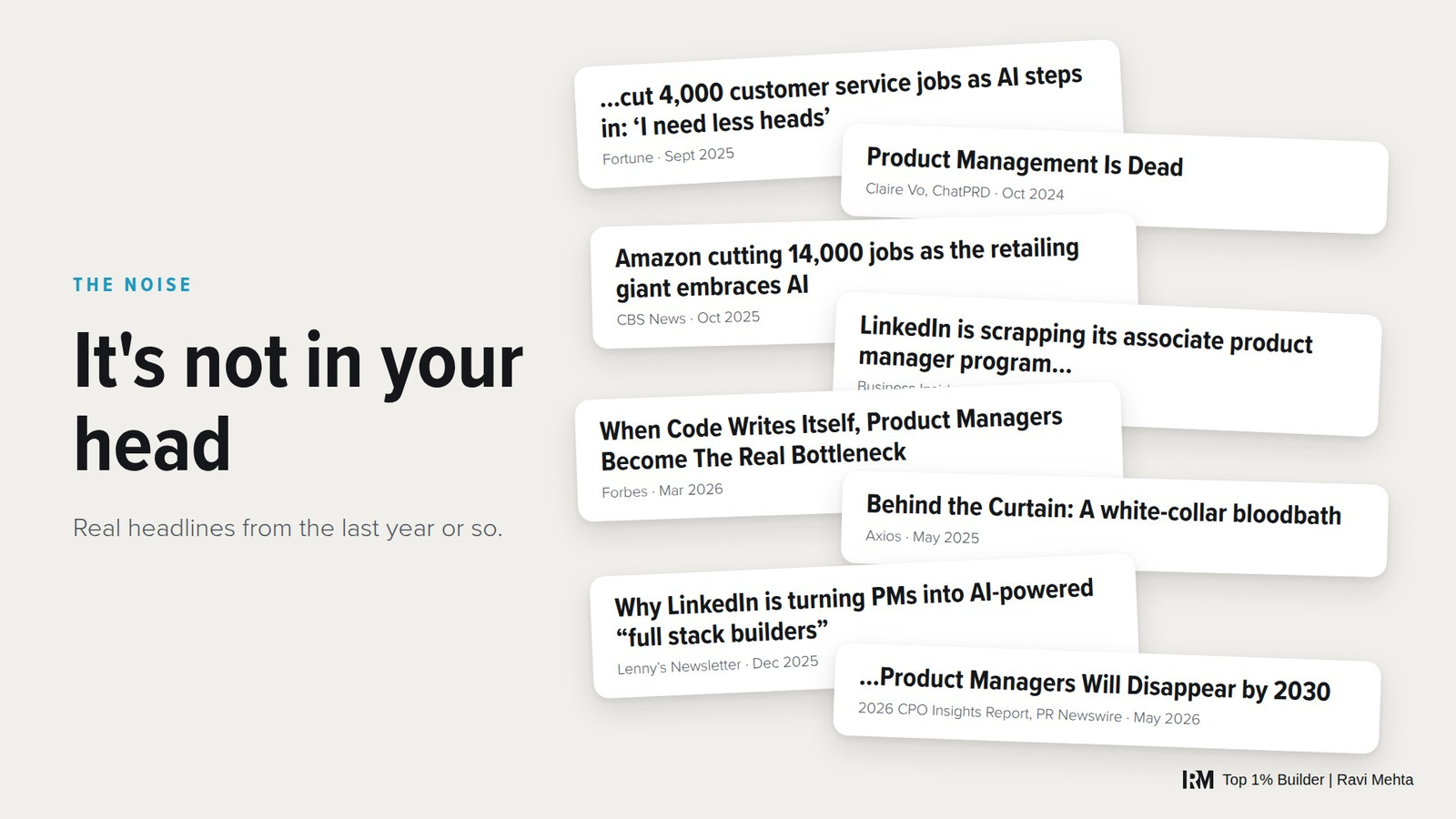
Here’s what I see when I talk to product people every week:
Nobody is less busy than before. If AI were taking the job, you’d expect the opposite.
Some of the hype looks to me like fear-mongering in the interest of other people’s economic gain, a lot like the crypto hype from a couple years ago. The tough part is real: companies are downsizing. But some of them are starting to hire back, and they’re learning what they gave up.
Don’t trade talent for tokens.
So if AI isn’t taking the job, what is it doing to it?
What changes when building gets cheap
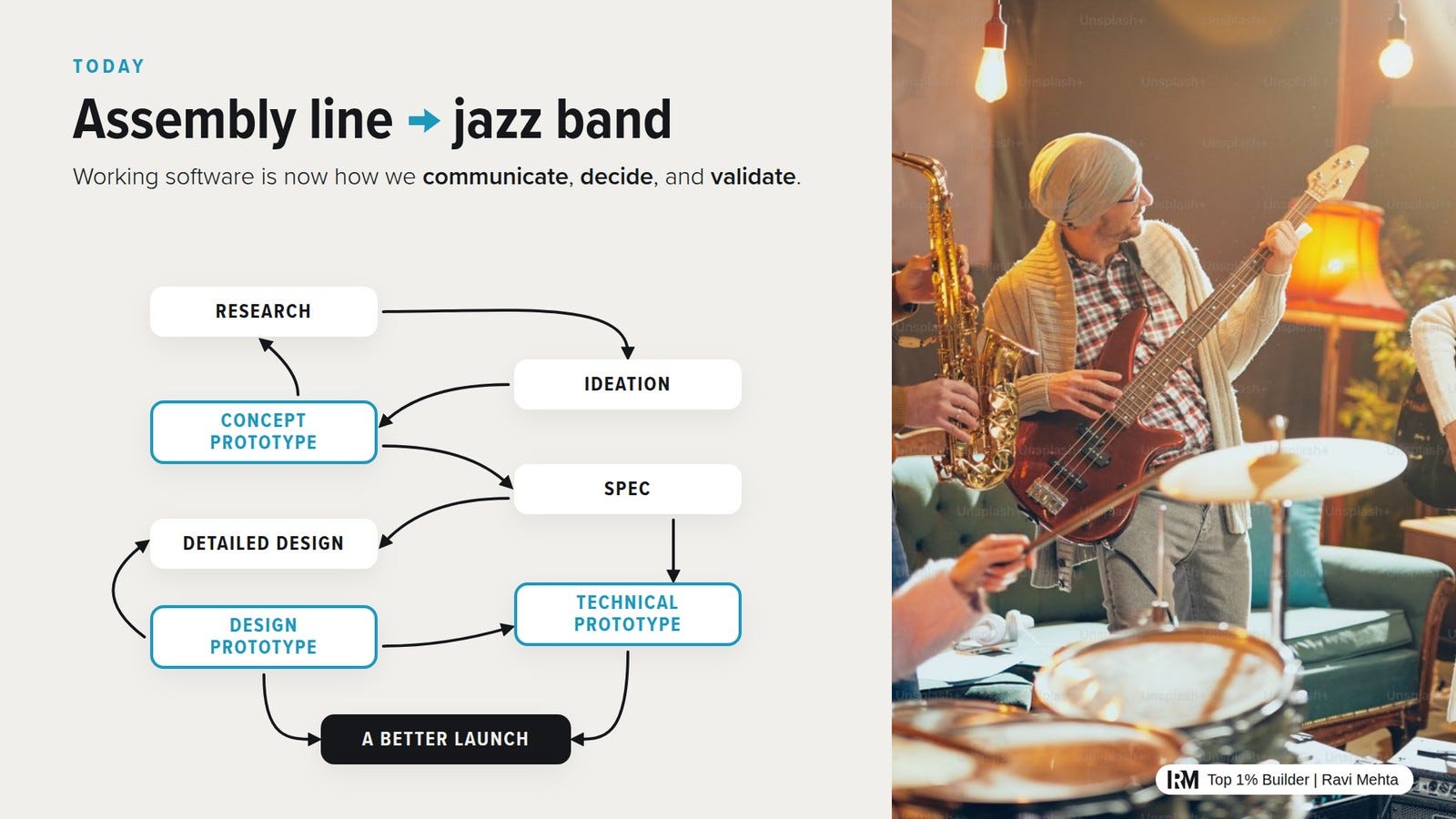
Product management “best practices” were built on one idea: building working software is expensive. So we designed systems around that cost. Specs came first, because they’re cheap to write. If there was enough conviction, we moved to wireframes, then detailed designs, then engineering.
It worked like an assembly line, one phase after another, each one gating risk.AI collapses that cost. It’s now sometimes faster to build a working prototype than to write a PRD. Earlier this week I gave a talk at Ford, the company that invented the assembly line, and even they are rethinking how software gets made.
The jazz band replaces the assembly line
Like a jazz band, design, engineering, and product each have their own instrument to play — we don’t need everyone on drums. Now, they riff off each other, and the lead moves from player to player depending on the question in front of you. You can go back to the beginning. You can skip a step. You can build a lot of things you never ship, and the thing you do launch is more tied to what creates value for customers and for the company.
One attendee wrote that this will be tough for companies that still think command and control is the way. Another wrote that AI has increased command and control at their company, not small-team empowerment. these are common failure modes that I hear about all the time. Read to the end for thoughts on how to improve accountability and how to get engineers excited about this new model of working
Minimum viable gives way to most lovable
We shipped minimum viable products for one reason: building was so expensive. How many customers want a product that barely solves their problem? None. We did it for ourselves, not for them. Now we can aim for the most lovable product. Build more. Test more. Throw more away. Ship less, and ship better.
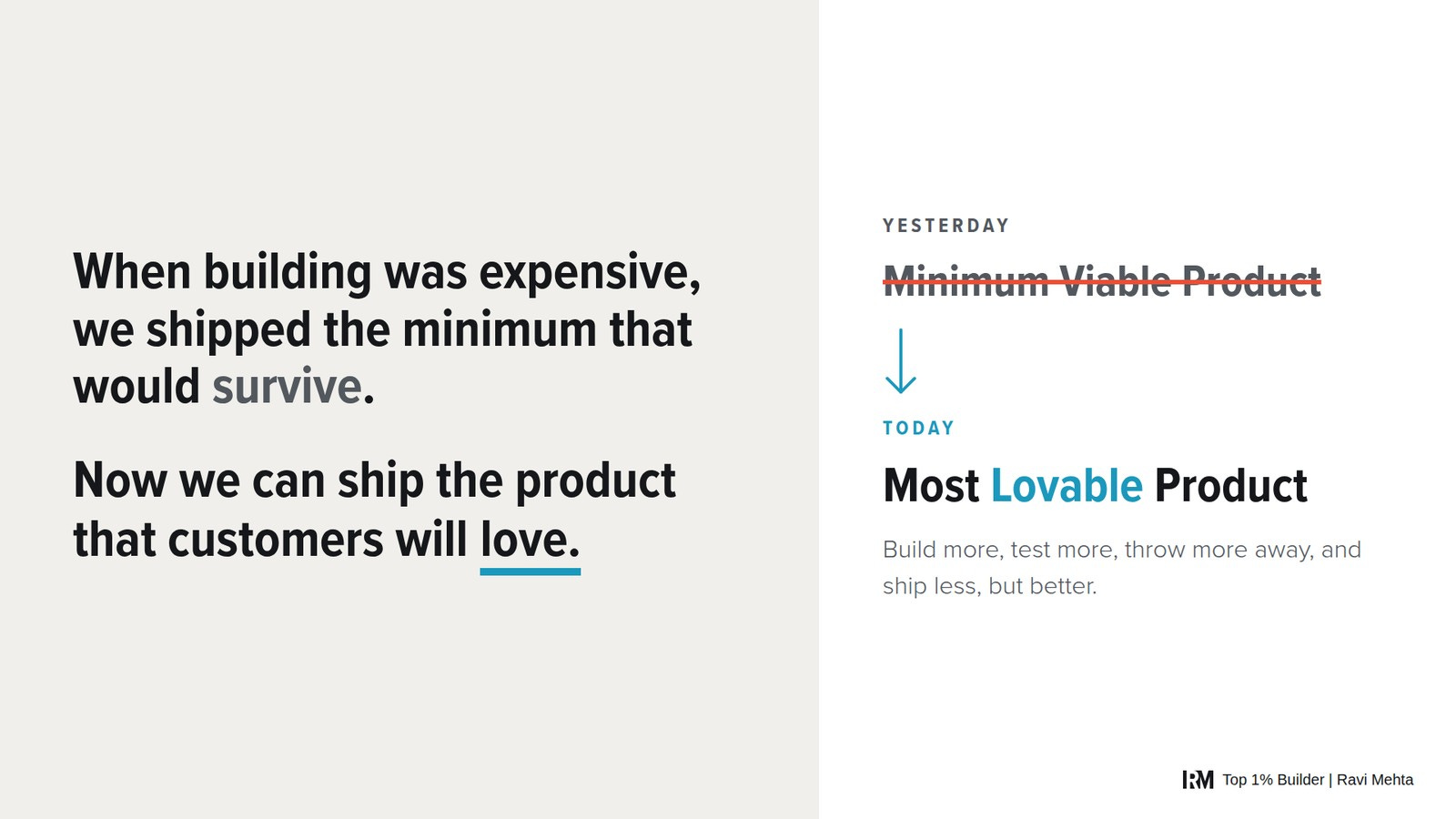
That adds a step before launch, where you decide whether to launch at all. After the hard work of building something, it’s painful to consider that we might not ship what we built. In the past, when the cost of building working software was so expensive, that pain was too great to bear.
Now, curation is an essential step in the product development life cycle. Some of the best products will be defined by what teams choose not to ship — by holding the line on what is customer-worthy.
This point is controversial, and teams ask me, “If we built it, why not ship it and A/B test it?” You probably don’t have the traffic to test everything to significance. Your customers don’t want the product changing under them every week. And we’ve all used products that feel like an accumulation of A/B tests instead of something thoughtfully designed.
Cut the ship. Choosing not to ship takes courage and discipline.
This is the shift from prioritizer to curator:
When building was expensive, the question was “is this worth building?”
Now the question is “is this worth shipping?”
Want to get better at deciding what deserves to ship? Join Now and bring your own product to office hours with me.
AI gets you to the hard part faster
AI doesn’t make our job easier. It gets us to the hard part faster.
AI speeds up the work machines can do: writing and shipping code, analyzing data, drafting PRDs, generating tickets and status reports. It doesn’t speed up the work people do. Talking to customers. Helping them build new habits. Getting a room of stakeholders to line up behind a decision. Convincing your boss, which may take longer now, because everything is moving so fast that conviction matters more before you pick a direction.
One attendee put it in one line in the chat: “Product building: move at AI speed. Product management: move at human speed.” Another added, “You can share data faster, but that does not imply a shared understanding.”
There are also two kinds of speed: velocity and latency. Most people try to get faster by maximizing velocity. The better move is to minimize latency, the time from an idea to a result.
Speed doesn’t come from maximizing velocity. It comes from minimizing latency.
Here’s the test I use on any company. If changing a button from “Shop” to “Buy now” would raise conversion, can you ship that today or tomorrow, or does it take a month? the code change won’t take long at all, and never did. Yet for many companies, it can take a month or more for that change to work its way through the process. AI might be helping those companies write more code, but it’s not helping them move any faster.
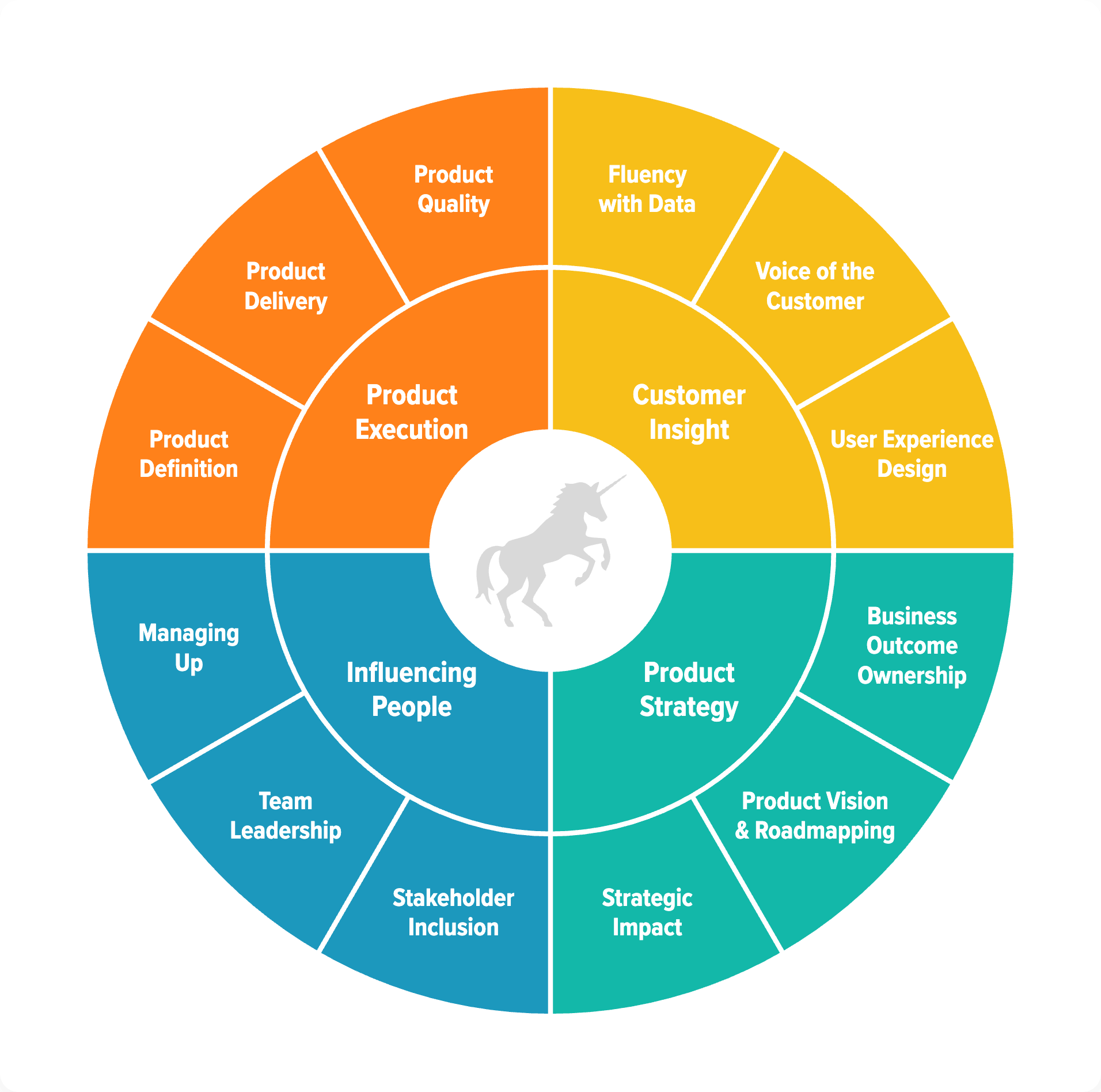
The 12 product competencies, from scratch
I first published the product competencies in 2020, weeks into lockdown, as the Product Competency Toolkit. Thousands of people used them to understand themselves, level up their teams, and chart a career on purpose instead of by accident. I’ve now rebuilt them for the AI era.
They’re the 12 skills I think a team needs to build products customers can’t live without. No single person is great at all 12, and a well-rounded team needs people with different strengths. They apply to anyone who contributes to product, not only people with a PM title. The list looks a lot like the old one, because the shape of the job hasn’t changed much. What changed is how you do each one.
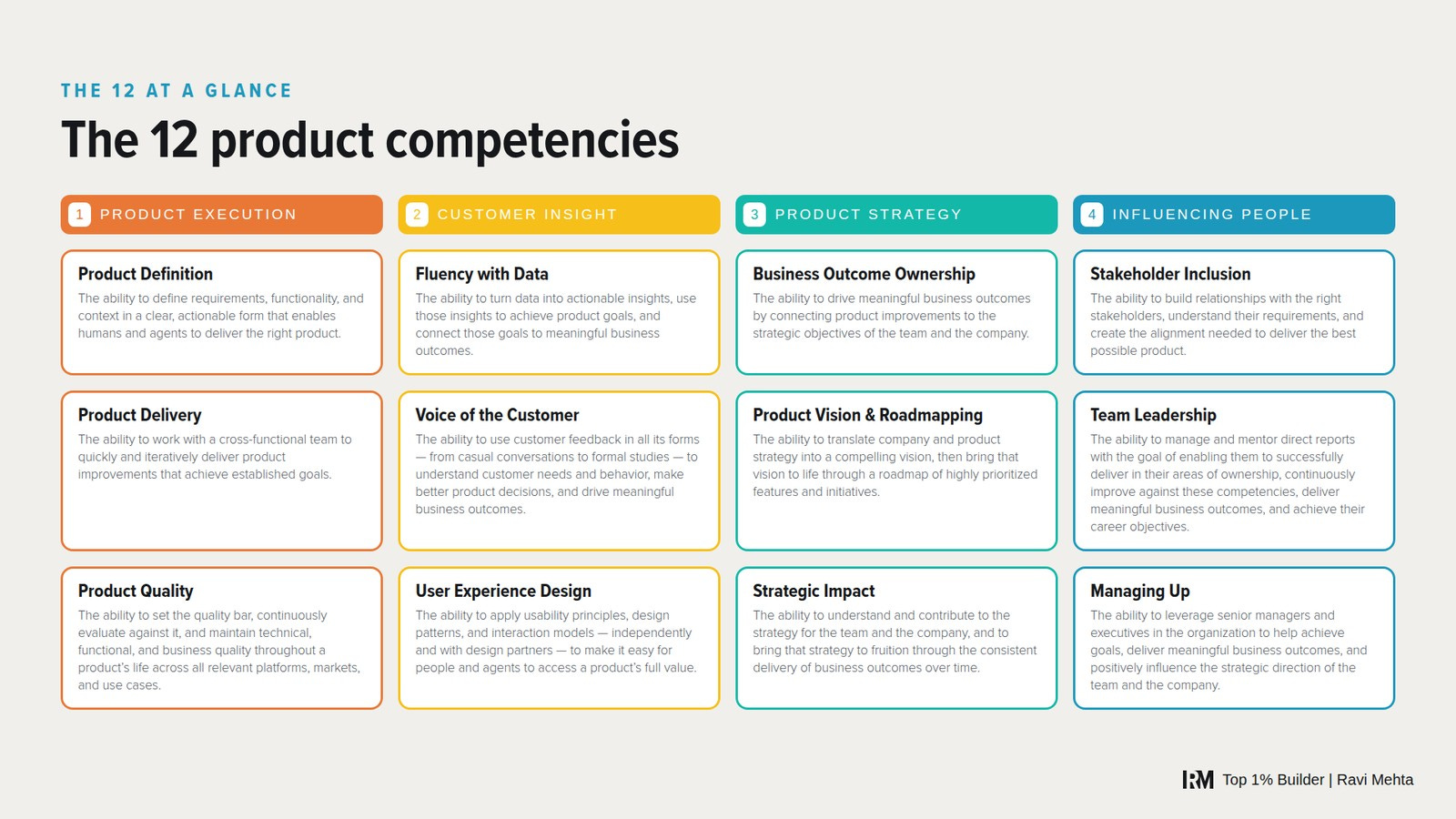
Product Execution: getting the right product built well
Product Definition is deciding what the product is and getting that across so a team can build it. It used to mean writing static specs. Now you can define a product with a working prototype, and engineer context for humans and AI agents alike.
Product Delivery is working with engineering to get the product built. The old goal was to hand off a spec and protect the sprint. Now you shape the product as it emerges, with humans and agents in the loop.
Product quality is making sure the product works, reliably, in a way customers can trust. It used to be a checkpoint. Now it’s a living system, because products are personalized, capabilities change, and models drift.
Customer Insight: understanding the people you build for
Fluency with data is using data to understand why customers do what they do. It used to be reporting, dashboards, and SQL. Now you can build causal models of customer behavior, starting from the decisions you need to make.
Voice of the customer is hearing what customers tell you. Now you can use LLMs to turn feedback and transcripts into a sharp picture of your customer, and put a prototype in front of them that they can see as vividly as you do.
User experience design is shaping the door customers walk through to get value from your product. Interfaces used to mirror the software underneath, so customers had to mold how they work to fit. Natural interfaces like chat and voice change that. Descript lets you edit a video as a script instead of a timeline.
Product Strategy: choosing the outcomes that matter
Business Outcome Ownership is being responsible for moving the metrics that matter. It used to mean rationing scarce engineering time. Now capacity is abundant, so the skill is the judgment to point it at the right outcomes. Motion isn’t value.
Product Vision and Roadmapping is setting the direction and planning how to get there. Now you can define a North Star and build toward it at the pace OpenAI and Anthropic innovate. When you move that fast, knowing your direction matters more.
Strategic Impact is the sum of your business outcomes over time. A roadmap is an accumulation of features. Strategic impact is an accumulation of smart business outcomes, so the goal now is compounding wins.
Influencing people: leading in every direction
Stakeholder Inclusion is leading across. I renamed it from Stakeholder Management, because things move too fast to manage everyone involved, which is like herding cats. Customer support, sales, and forward deployed engineers all have a view on what to ship, and now they can build prototypes that add to the conversation instead of constraining it.
Team Leadership is coaching the people on your team to do the best work they’ve every done. AI takes over coordination work like slinging JIRA tickets, so you can coach a team whose strengths fit together. I don’t think everyone will become a super IC — a company without leaders can’t lead.
Managing Up is getting the support you need from executives, by being seen as an ally in helping them achieve their strategy. Leadership decisions used to be slow and manual, with quarterly business reviews. Now they need to be fast.
Want the deep dive on all 12, including a 36-question assessment and AI skills for each one? Join Now and get them the day they ship.
Find your product management strengths
You can’t be equally good at all 12 competencies. Nobody is. Individuals should be spiky, and teams should be well-rounded. Your shape is the pattern of where you’re strong and where you’re not, and it tells you what to build on and who you need beside you.
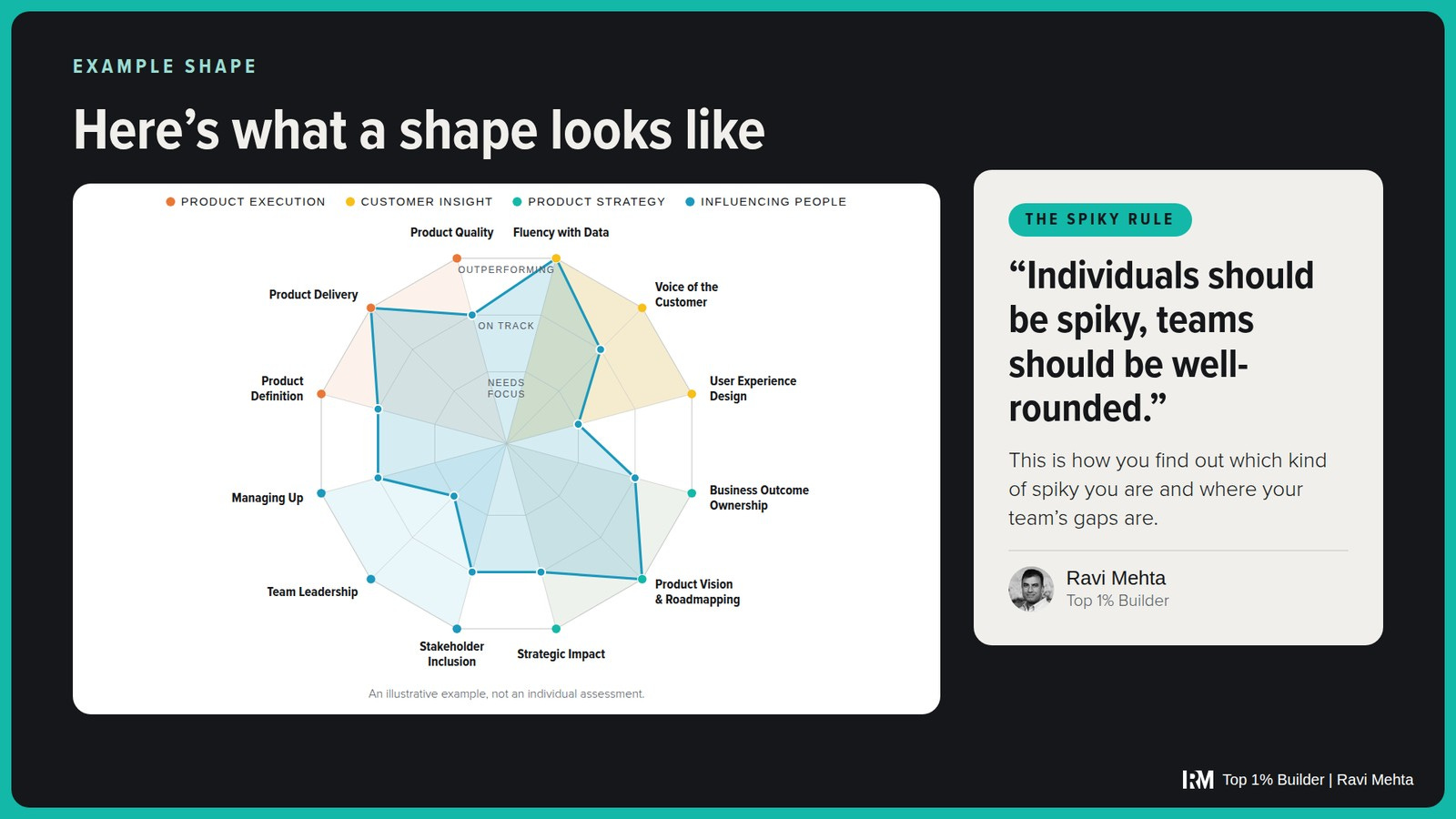
Find your strengths, and cover your gaps
Ask your peers and your manager what you do best. That’s where you’ll build remarkable products, and where you’ll stay ahead of AI no matter how good it gets. I cited a McKinsey study, done with the search firm Egon Zehnder, finding that organizations that encourage people to be spiky outperform organizations that focus on fixing weaknesses. An attendee shared a line from a mentor that says it well: “You’re hired because of your strengths, so don’t stop working on them.”
Then cover your gaps, but don’t chase them. Say you get your energy from User Experience and Voice of the Customer, and less from Fluency with Data. You still need data fluency to make a great product, but it doesn’t have to come from you. You can lean on a data analyst, or decide to invest in getting better.
It’s also why I don’t believe in the “full stack builder” — a single person that is expected to do it all. One week the advice is that every PM should spend time shipping their own code. The next week it’s that PMs are the bottleneck. Both can’t be true. It’s impossible to be great at everything a great PM needs, let alone everything a great engineer, designer, user researcher, and data analyst needs.
In the live hot seat, a product leader named Voice of the Customer as his spike. He described how people can say they want a boat or a bus, when the real problem is that they live on the other side of the lake and they’re stuck. That’s the muscle: hearing the emotion and the reason behind what people say. I think empathy with customers separates you from everyone else, and it’s where you add the most value as context for AI.
Take the 5-minute Product Competency Assessment
Go to ravi-mehta.com/assessment.
Enter your title and roughly where you sit in your organization. The tool shows what’s expected of you at that level, even if you’re not a PM.
Rate each competency as on track, outperforming, or needing focus. On the first page, the colored boxes only show how important that competency is at your level, so press Next to rate yourself.
Mark up to 3 as outperforming. If your gut says you’re good at something, trust it. The cap of 3 is the point, because it forces a shape.
Mark up to 3 where you need focus. That could be something you want to improve, or something that isn’t in your wheelhouse. The other 6 are on track.
Download your report (as a PDF, Word doc, or Markdown file). Need some coaching? Paste the Markdown file into ChatGPT and ask some key questions on how to get better.
Then ask your manager to take it too, and compare notes. Where do you agree you’re outperforming? Where do you agree you need focus? Where do you disagree? Spend 10 minutes on that before your next one-on-one. I think it leads to the most valuable one-on-one you’ve had in a while.
Know your spike and want to make it sharper? Join Now and take your shape to office hours with me.
Build a team from shapes
A team has a shape too: the sum of the shapes of the people on it. A PM who’s great at User Experience Design and Voice of the Customer can lean on a data analyst. A PM who’s great with data but light on user experience can lean on a designer. When you hire, describe the shape of the person you want, not only the job description, and push yourself to hire someone different from the average on the team.
Stack the shapes of 10 people and you may find a well-rounded team. Or you may find everyone bunched around one shape. A growth team, for example, is often focused on Business Outcome Ownership and Fluency with Data, and that can create blind spots, like treating customers as if they’re in a petri dish.
I described an example from the travel industry: HomeAway prides itself on being a data-driven company and was able to consistently drive growth using an analytical approach. They were the number one vacation rental company for many years. Airbnb took a more well-rounded approach, thinking about vacation rentals not just as a transaction between a property owner and a renter, but as a human social interaction between a host and a guest. They rethought the marketplace by putting customer empathy at the center. With that reframe, they grew faster and now eclipse HomeAway in market share.
Leaders need a talent roadmap the way PMs need a product roadmap.
Three hard questions
Who’s accountable when everyone can contribute?
Let everyone contribute, and be clear about who’s accountable for the bar. Engineering is accountable for software quality, scalability, performance, and architecture. Design is accountable for design systems, interaction patterns, and the fulfillment of the user experience. Product is accountable for impact and business outcomes.
If you try to limit what people do, you create seams between teams. If someone in customer support wants to make a prototype, that’s great. If a designer wants to write code, that’s great. Include the right people, and don’t dilute the decision. It should be made in the name of the customer, not in the name of the stakeholders.
How do I get engineers to play jazz?
Ask what they’re worried about. On teams that resist, I think a lot of it is fear. If AI can write all of this code, what is my job? Will everyone else write code and leave me to clean it up? Will I become a full-time code reviewer who no longer a code creator?
Ground rules help. The one I like most: prototypes are for learning, and production software is for shipping. Someone shows a prototype to a VP, and the VP says it’s done, let’s ship it. If you agree up front to throw the prototype away and let engineers build the real thing the right way, they stop worrying about inheriting code that doesn’t fit their stack — they stop worrying about having to clean up someone else’s mess.
Instead, engineers can focus on working quickly with you and others to solve for the customer. They can focus more on what their code is actually mean to do (to create features customers love). Once engineers work this way, it can be intoxicating.
Stuck on a hard question you can’t take to your own team? Join the Top 1% Builder Club and bring it to office hours with me.
What does progression look like if every PM works the same way?
An attendee asked this one live. It depends on whether the company gives ICs real decision rights. If every PM is expected to be a full-stack IC, those people need to be empowered to make decisions, check in code, move metrics, and set strategy. Most companies want the expectation without the empowerment.
The day before the workshop, someone wrote to me after moving from a manager role to an IC role. They have a set of pull requests ready to commit, nobody is reviewing them, and they don’t have approval rights on the repo, so the work is stuck. Help your leaders step back and look at what’s happening on the ground: what’s moving faster, what isn’t, and where you’re stepping on each other’s toes. Another attendee, who manages a large team, wrote that ICs are desperate to understand the larger company strategy, and that this leadership work isn’t going away. I agree.
Questions we didn’t get to
We ran out of time before these, and we’ll answer as many as we can next week. Look out for the email.
How does AI change the decision between being a manager and being a high-agency IC?
How do we use a competency gap to move up a level? Can we see an example of how levels work within a competency?
If the most lovable product means bigger bets, how does that fit with the jazz band?
How does this apply to businesses that deliver physical products, where prototyping isn’t nearly free?
If building gets cheaper but customer learning still moves at human speed, does discovery become the real bottleneck?
Has building actually gotten faster, when engineers report a 10 to 15% productivity gain?
Your workshop resources
My goal is to create the most valuable place for people who want to build remarkable products:
Shape assessment: ravi-mehta.com/assessment. A 5-minute self-assessment across the 12 competencies, free, for anyone who contributes to product:
Product Competency In-Depth Assessment and AI Skills (coming soon, for Club members): a 36-question deep dive on all 12 competencies, with AI skills for each one. Club members get it the day it ships.
Free live 12-week series (fall 2026): https://luma.com/top-1-builder-series. One competency per week, starting Thursday, October 8. Free live this fall only. In 2027 the series is paywalled. The first session covers product definition and how PRDs and prototypes work together.
Top 1% Builder on Substack: blog.ravi-mehta.com/subscribe. Free subscribers get my last 4 weeks of articles and the free live series. The Club adds the rest.
Workshop replay: Watch on Zoom, password
?7kcy?tY. Free until 11:59 PM PDT on September 30, 2026, then open to Club members. Slides are for Club members.
Jump to a topic in the replay: the three claims at 5:43, building gets cheap at 10:30, the jazz band at 11:12, curation at 14:31, the 12 competencies at 16:49, the assessment at 34:17, strengths and gaps at 44:28, the live hot seat at 1:01:12, accountability at 1:08:03, latency at 1:13:38, engineers at 1:16:08, and team shapes at 1:22:17.
Your next steps
This week
Take the shape assessment. Mark up to 3 competencies where you outperform and up to 3 where you need focus.
Ask your manager or a trusted colleague to take it, and compare notes for 10 minutes before your next one-on-one.
Pick one strength and ask a peer and your manager what they see in it.
For each gap, decide whether to cover it with a teammate or invest in it. Don’t chase it.
Ask how long it would take to ship a button label change. If the answer is a month, find the step that adds the delay.
This month
Join the free live series starting October 8, and attend the session for your sharpest competency.
If you lead a team, put your team’s shapes side by side and look for where they bunch up and where the gaps are.
Decide with your engineering partners where prototypes stop and production software starts, and write it down.
When you hire, describe the shape you want, not only the job description.
What’s in the Club
The Top 1% Builder Club is designed to help you build products customers people love, remarkably.
Free for everyone
My last 4 weeks of articles on Substack
The 12-week Top 1% Builder Series (a deep dive on the 12 competencies) live attendance only. (Replays and decks sent to paid members.)
The Product Competency Assessment and the fully updated Product Competency Toolkit
Yesterday’s workshop replay until 11:59 PM PDT on September 30, 2026
Club members add
The workshop replay and slides, after September 30
Replays of every session in the live series, plus the hot seats
Office hours with me, for your real product questions
The Product Competency In-Depth Assessment and AI Skills: a 36-question deep dive on all 12 competencies, with AI skills for each one (coming soon)
The 12-part course on demand (coming early 2027)
Club perks, including course discounts, AI tools, and community (coming soon)
The full archive: 100K+ words from 20+ years leading product at Facebook, TripAdvisor, Xbox, Microsoft, and Tinder and consulting with some of the most recognizable names in tech
A paid subscriber wrote: “It should be required reading for any product folks in the AI era.”
Why I priced it this way
Jeff Bezos has said he wanted there to be so much value in Amazon Prime that you’d feel it was irresponsible not to buy it. I want the Club to work the same way.
I put everything I could into it: the full archive, the course, office hours with me, the deep-dive assessment and AI skills, and a live series that’s free this fall so you can bring your team. I set the price so it’s accessible and sustainable, which lets me keep showing up for the product world I care about. My bar is simple. It should be some of the highest ROI you get on your own growth.
Two ways to join
$25 a month. Everything in the Club. Cancel any time.
$180 a year, about 5 months free compared with paying monthly. This price ends at 11:59 PM PDT on September 30, 2026. From October 1, the annual price is $250.
Ready to become a remarkable product builder?
Try it risk-free. If the Club isn’t for you, email us within 30 days for a full refund. Wondering if you can expense it? Most likely. Substack gives you a receipt, and group subscriptions cover a whole team. If you’re bringing a team, reply to this email and we’ll help you choose the right option.
Founding membership with the AI Strategy Lab
For 20 people, the Club plus a workshop I first taught to product leaders in Berlin last week.
$500 a year, 20 seats. It includes a full year of the Club. Enrollment is limited to 20 seats.
Two live AI Strategy Lab workshops, 2 hours each, with me, starting early December.
What you get: the Berlin frameworks on how customer expectations are shifting, your AI disruption risk, and the anatomy of a winning AI product. Plus the Lab workbook, my feedback on your strategy, and a 90-day plan.
Why it exists: most organizations have lots of output and too little judgment in it. The question is shifting from “are people using AI?” to “are we building better products because of it?”
Only offered here. When it ships in 2027, the Lab is expected to cost $3,000 or more. Founding members get a full refund any time before the first Lab.
You got this
The PM I spoke with yesterday was asking whether there’s still a career here. Underneath, I think she was asking whether being good at building products still counts.
It does. The market is hard right now. Companies are downsizing, and the loudest voices keep telling you the ground is gone. But AI didn’t take the PM job. It exposed the one we should have been doing all along: the judgment, the craft, and the empathy for the person on the other side of the screen. That’s what turns a great product builder into a remarkable one, and a product that ships fast into one that customers love.
Reply with what you’re building, or the question you’re carrying. I read what comes in.
Ready to build products customers love the most? Join Now.
Ravi
P.S. Thank you to everyone who shared what they’re building and asked hard questions. Your ideas made the workshop better, and I quoted several of them above. Thank you also to the product leader who sat in the hot seat. If you’ve been quietly wondering, “Do my hard-won skills still matter?” you’re not alone, and they do. Take the 5-minute assessment, and bring your shape to the first live session on October 8. Reply to this email with questions, or join the conversation in the Top 1% Builder community.
About the author. Hi, I’m Ravi 👋. I've hired 100+ PMs, led product at Facebook, TripAdvisor, Tinder, and Microsoft, taught tens of thousands at Reforge, and advised some of the most recognizable names in tech. Thanks for being here.
I'd like your questions reframed for founders. I think the skills I acquired as a PM are especially valuable to me as a founder. AI has made me much faster with with outputs like design and code but AI will never be able to assess the emotional state of people and how feelings fluctuate like the wind which can determine outcomes. User insight, strategy, influence... Tie this to consumer and we have a niche that AI can never touch.